Restoring a VM Is Not the Same as Restoring a Service
A virtual machine can boot while its database, workers, or network assumptions remain broken. An isolated restore needs application-level proof.

When a virtual machine boots after a restore, it is tempting to call the recovery successful. The operating system started. The disks are attached. Perhaps a container is running.
That is a useful checkpoint, but it does not tell us whether the service came back.
During a recent VM move between hypervisors, I used an isolated restore to check more than the imported machine. The test had to show that the data was readable and that the application’s background work could continue.
Isolate before starting anything
The restored guest started with no virtual network interfaces. That prevented duplicate IP use and stopped the recovered copy from contacting production dependencies. Before Docker started, container restart policies were disabled so that workloads could not unexpectedly begin against production-like names or credentials.
The isolation is part of the test. If a restored copy can reach production, a verification step can accidentally become a second writer.
The guest was configured to get past waits for network services that could never become available in the isolated environment. That let the restore test evaluate the guest and its local data without pretending the production network existed.
Verify the application’s data
After the machine came up, the database check was application-aware. We inspected schemas and ran PostgreSQL’s pg_amcheck against the restored database. A running database process alone would not have shown whether its internal structures were readable.
Then we checked the worker. The first attempt timed out during cold start, which was a useful failure: a stale health marker or process state could not count as fresh evidence. After the worker initialized, a new receipt proved that it had completed a real unit of work against the restored state.
That gave us separate evidence for three layers:
| Layer | Evidence |
|---|---|
| Virtual machine | Guest boots in the target hypervisor |
| Data | Schemas are present and database checks complete |
| Application work | A newly created worker receipt is observed |
Each layer answers a different question. None can stand in for the next one.
Keep recovery material after the test
The restored copy was disposable; the export used to create it was not. We retained the VM export and a small verification record describing the isolated restore. A scheduled export had been configured, but the first scheduled run and a separate off-site copy still needed observation.
That last sentence is important. A configured schedule is not a completed backup. A completed backup job is not an isolated restore. A restore is not proof that every dependent service or external integration works.
A practical restore definition
For a service backed by a VM, I now treat “restore succeeded” as a set of claims:
- The correct backup artifact was selected and verified.
- The guest starts in isolation, without competing for production identity.
- The database opens and passes the relevant integrity checks.
- The application starts with the expected schema and local configuration.
- A fresh background job or other representative action completes.
- Temporary recovery resources are removed, while the recovery artifact remains available.
There may be more for a particular system: object storage, identity providers, DNS, payment processors, or user-visible browser flows. The point is to name those dependencies rather than let a boot screen imply that they were tested.
Recovery evidence should describe exactly what was restored and what was exercised. That makes the next outage less dependent on optimism.

Keep reading
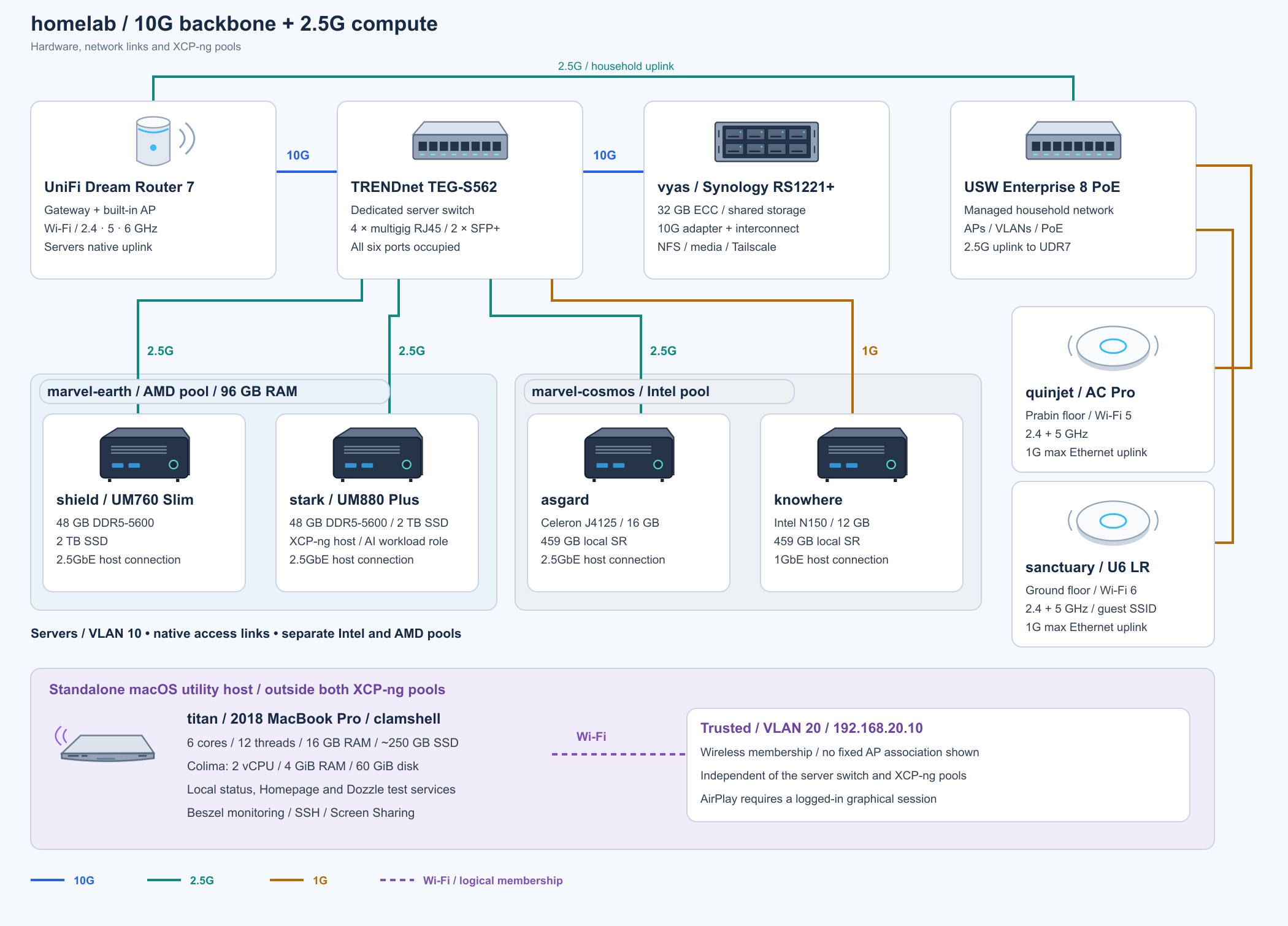
My Homelab Goes Multigig: 10G Networking and 160 GB Across Two Minisforum Hosts
A dedicated 10G server backbone, 2.5G compute links, and two Minisforum hosts: Talokan with 96 GB for XCP-ng and Shuri with 64 GB for Ubuntu, gaming and local AI.
Letting Coding Agents Build It: An Orchestrator, Parallel Lanes and Verification Over Trust
Much of the Campsite work in this series was implemented by coding agents in parallel worktrees, coordinated by another agent. What made that work was re-checking every result before it merged, and learning from the times it went wrong.
From MySQL to PostgreSQL with Patroni HA: A Migration in Progress
Campsite is moving from MySQL to PostgreSQL. The test suite now passes on both, a small Ruby copier replaced pgloader, and a Patroni cluster is live across three hosts. Production still runs on MySQL, and here's why.
What did you take away?
Thoughts, pushback, or a story of your own? Drop a reply below — I read every one.
Comments are powered by Disqus. By posting you agree to theirterms.