Same Model, Five Times the Tokens: What My Agent Harness Was Sending
One gem upgrade through Claude Code, Codex, Pi and Hermes showed the harness, not the model, decided whether it cost 37,000 tokens or 190,000.

This morning a routine Pi session ate through more of my Claude allowance than I expected. I’ve only been using Pi for a short while, and early on is the best time to find out a tool is expensive. So I stopped guessing and measured it.
I started from a common suspicion: that Claude bills subscription usage more heavily when it arrives through third-party software. That turned out to be the wrong question. Every Claude path I tested ends up in the official claude CLI on my own login. What changed the bill was everything each harness packed around my prompt before the model saw it.
The first warning sign
My first probe was a patch upgrade of a development-only gem in my Rails app, with no commit. Pi with my everyday configuration used 190,211 tokens, almost all of them cache writes, and still failed because its shell picked up the wrong Ruby. Pi with every extension, skill and context file switched off did the same job in 37,271. Same model, same login, same prompt, five times the tokens.
That was enough to justify a proper comparison.
The real test: upgrade, verify, commit
The main test used Campsite, a Rails API I work on. Each harness got the same instruction in a fresh git worktree:
In this repository's api/ directory: upgrade the brakeman gem to 8.1.1 with
'mise exec -- bundle update --conservative brakeman' (run 'mise trust' first if mise asks).
Verify 'mise exec -- bundle exec brakeman --version' prints 8.1.1. Commit only
api/Gemfile.lock with the message 'Upgrade brakeman to 8.1.1'. Do not push.
Success meant a commit on the branch, so there was no room for a confident “done” that hadn’t happened. Claude Code, Codex and Pi ran on my laptop. Hermes ran on Friday, a 4-vCPU VM in my homelab where my agent runtime lives.
| Harness | Model | Committed | Tokens | Est. API cost | Time |
|---|---|---|---|---|---|
| Hermes, tuned lean profile | Sonnet 5.5 | ✅ | 39,073 ¹ | $0.004–$0.10 ² | 119s |
| Pi, lean | Sonnet 5.5 | ✅ | 66,006 | $0.108 | 32s |
| Pi, everyday setup after cleanup | Sonnet 5.5 | ✅ | 82,624 | $0.196 | 33s |
| Claude Code, trimmed | Sonnet 5.5 | ✅ | 108,092 | $0.064 | 25s |
| Hermes, full engineering profile | Sonnet 5.5 | ✅ | 135,585 ¹ | $0.014–$0.34 ² | 167s ³ |
| Codex | GPT-6 Luna | ✅ | 222,023 | $0.006 | 39s |
Costs use list API prices. Sonnet 5.5 is $2 per million input tokens, $10 output, $0.10 cache read and $2.50 cache write. GPT-6 Luna is $0.10 input and $0.50 output. On a subscription none of this is billed in dollars, but the same tokens draw down the same allowance.
¹ Hermes’s numbers are self-reported and I couldn’t verify them. A trivial one-word reply cost 16,957 tokens through the claude CLI directly, but only 7,141 by Hermes’s own count. Either Hermes replaces Claude Code’s long system prompt with a shorter one, or it undercounts. Treat those rows as a floor.
² Hermes doesn’t break out cache reads and writes, so its cost is a range between the two.
³ The full profile ran after the lean one had already downloaded the gems, so its time looks better than it was.
What the numbers say
The harness matters more than the model. Lean Pi and trimmed Claude Code drove the same Sonnet model through the same CLI. Pi sent about 60% of the tokens. Hermes’s full profile sent roughly three and a half times what its lean profile did.
Tokens and cost don’t rank the same way. Pi used fewer tokens than Claude Code but cost more, because it wrote its prompt to the cache on each call where Claude Code read it back. Cache writes cost 25 times as much as cache reads, so a harness that caches well can send more tokens and still cost less.
Codex is in a different price class. It used the most tokens and cost under a cent, because GPT-6 Luna is a far smaller model. Whether that trade is right depends on the task. For a lockfile bump it was fine.
Rebuilding Pi
My everyday Pi configuration carried about a dozen extension packages, a GSD workflow layer, over a hundred skills and a 28 KB global policy file. Each was something I had tried in my first weeks. Together they meant a trivial “say ok” cost 91,658 tokens.
I cut it back to three packages (the Claude provider, a status line and a usage meter), one small extension, six short skills written for Pi, and a 1.7 KB AGENTS.md holding only the rules that matter for coding. The same trivial prompt now costs 16,709 tokens. Everything removed is parked in a disabled/ folder rather than deleted, so I can bring back whatever I miss.
Caution
One cleanup step went wrong in a useful way. Setting defaultTools to an empty list doesn’t mean “no extras”. It means no tools at all, and Pi’s next run failed with Tool bash not found. Removing the key fixed it.
Making Hermes usable
Hermes was the slowest by far, and the reasons had little to do with the model. After upgrading Friday to Hermes v0.23.5, a one-word reply took 193 seconds. Here’s where the time went:
- Lazy installs. On launch, Hermes was installing default messaging plugins into all 58 profiles on Friday, at about 80 seconds per plugin per profile. Setting
security.allow_lazy_installs: falsebrought a cold start down to 61 seconds. - The profile itself. A lean profile with memory off, only the terminal and file toolsets, and no MCP server cut the tool list from 70 tools to 8, and the tool listing from 13,299 tokens to 576. A trivial reply then took 43 to 59 seconds, of which the model call itself was 2 to 6.
- The machine. Friday’s multiplexed Hermes gateway uses about 63% of a CPU while idle, polling 58 profiles, which keeps the VM’s load near 4 on 4 cores.
A few traps worth knowing
- Close stdin. Non-interactive
pi -pwaited on standard input until I redirected it from/dev/null. - Interactive prompts hang agents. In a new worktree,
miseasks whether to trust the project’s config. Claude Code’s shell closes stdin, so mise fails fast and the agent runsmise trust. Pi’s shell leaves stdin open, so it waited six minutes for an answer that never came. Trusting the folder in advance fixed it, and mise’strusted_config_pathssetting in my dotfiles now covers every workspace folder, so a new worktree never prompts. - Don’t override your own sandbox config. My Codex config grants full access. Passing
-s workspace-writefrom a script quietly replaced it with a sandbox that blocked mise’s state directory and the worktree’s.gitfolder. - One Hermes launch at a time. Two concurrent Hermes commands on the same install deadlocked on the Claude provider plugin’s lock.
Hermes as the front door, Pi as the worker
Hermes is not really a harness. It’s an agent runtime: a long-running gateway that takes instructions from Telegram, Campsite rooms, a kanban board or cron, and keeps profiles, memory and schedules for them. It contains an agent loop, which is what the table above measured. As a router it’s useful. As the thing that edits code, it brings that whole runtime to every task.
So I split the two jobs. The lean Pi setup from my laptop now goes onto the VM through Ansible, with its own Claude token in a private file. On Friday it answers a one-word prompt in 8 seconds, against 43 to 59 seconds for the lean Hermes profile. A new Hermes profile called dispatch has one tool, the terminal, and one instruction: hand the task to Pi and return Pi’s answer.
These numbers come from Hermes’s own per-session usage table, which splits cache reads from writes, so unlike the first table they can be priced.
| Run | Result | Hermes | Pi | Total cost | Time |
|---|---|---|---|---|---|
1. Dispatcher runs pi -p | ❌ stopped before committing | 33,926 tokens, 3 calls | 36,249 | — | 487s |
| 2. Same, second try | ✅ | 32,472 tokens, 3 calls | 72,107, ~4 calls | ~$0.21 | 142s |
3. One-line pi-task wrapper | ✅ | 20,293 tokens, 2 calls | 111,921, 6 calls | ~$0.30 | 142s |
| Pi alone, thinking set to low | ✅ | — | 53,377, 3 calls | $0.12 | 52s |
The first run failed in an instructive way. On its second step, the model wrote its next shell command as plain text instead of an actual tool call, and Pi took that as a finished answer.
The second run worked but showed waste on the Hermes side. Pi’s raw JSON output was unreadable to the dispatcher, so Hermes made a third call to grep Pi’s log and run git log itself. A small wrapper, pi-task, now runs Pi, keeps the JSON log for measurement and prints only Pi’s final answer. The dispatcher dropped to two calls and about 20,000 tokens.
That made the remaining cost visible, and it sits in the bridge between Pi and Claude. In run 3, Pi’s six calls wrote 96,450 tokens to the cache and read back only 13,482. The claude-code-pi bridge starts a fresh claude -p for each Pi turn, so Claude Code’s long prompt is cached again every time and never reused. At 25 times the price of a cache read, those writes were about 90% of Pi’s cost. It also explains the main table: Pi sent fewer tokens than Claude Code but cost more.
Two other things moved the number. The same task took Pi four calls one time and six the next, so a single run says less than it seems. And my Pi profile was set to think at a high level by default. Dropping it to low halved the tokens, the calls and the cost on the same task, with the same commit. Low is now the default for the VM profile.
Making it repeatable
I don’t want to redo this by hand the next time I change a setup or try a new harness. The eval now lives in my homelab repository as a script. It reads one config file listing each harness and its exact command, and gives every harness a fresh git worktree, the same prompt, closed stdin and a time limit. A run passes only if the last commit has the expected subject. Tokens come from each tool’s own output, with Hermes marked as self-reported, and cost comes from a price table I keep current. Results are saved as JSON and Markdown with a timestamp, and a --trivial mode measures startup overhead alone.
What I took from it
Choosing a model is the decision everyone talks about, but on this test the harness around it set the bill. Lean setups beat heavy ones every time, often by a factor of three or more. A gateway like Hermes is worth having for taking instructions from anywhere, as long as the coding itself runs in something small. Every extension, skill and policy file rides along on every call, and it’s worth knowing exactly what yours is sending.

Keep reading
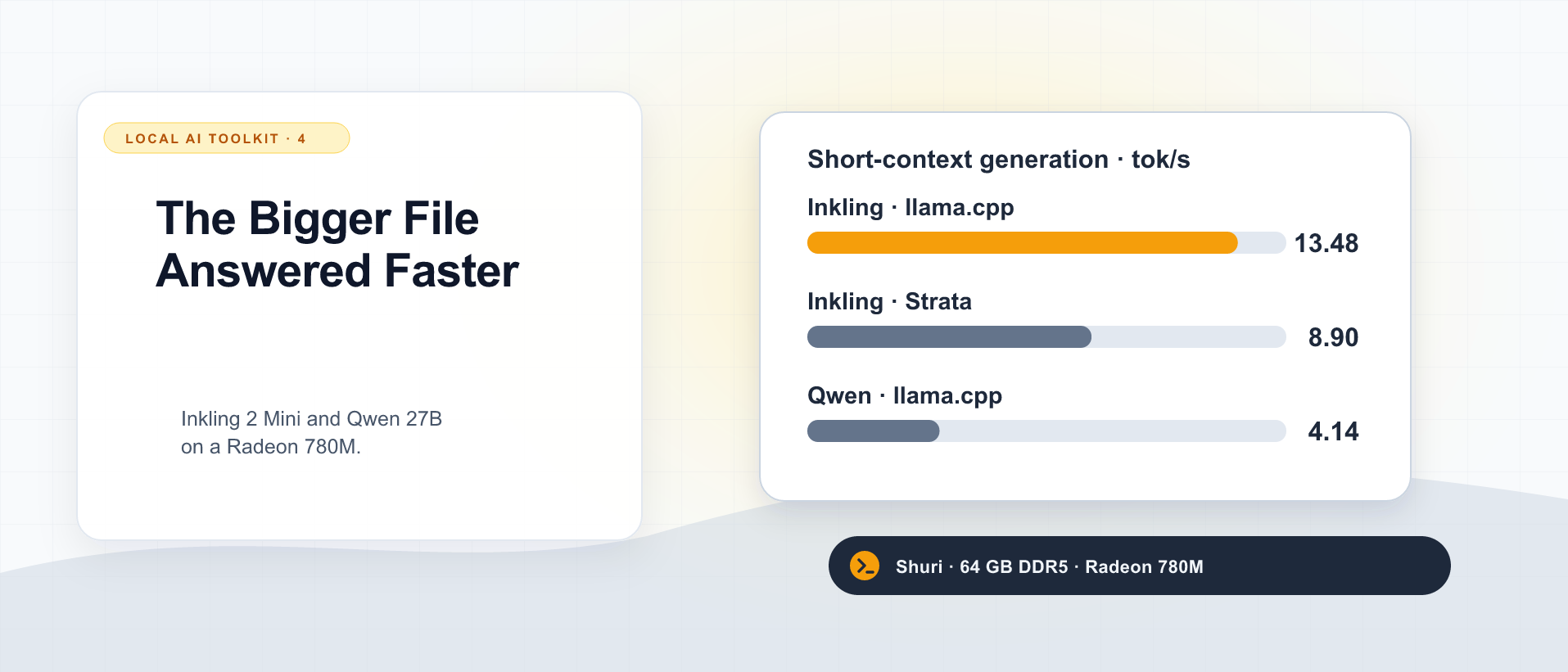
The Bigger File Answered Faster: Inkling 2 Mini vs. Qwen on Shuri
Two models took up about 16 GiB each. One wrote three times as fast. Then Strata made the faster model quicker at reading and slower at answering.

Agent Config, Installed Tool, and Live Behavior Are Three Different Things
A model or workflow can be correct in source and still be absent from the installed runtime. Verify each layer before claiming it works.
Running Independent AI Research Trials
Two isolated research environments can work from the same source material while keeping their analysis independent and reviewable.
What did you take away?
Thoughts, pushback, or a story of your own? Drop a reply below — I read every one.
Comments are powered by Disqus. By posting you agree to theirterms.