Agent Config, Installed Tool, and Live Behavior Are Three Different Things
A model or workflow can be correct in source and still be absent from the installed runtime. Verify each layer before claiming it works.
An agent’s configuration can be correct in a repository while the installed tool still uses an older model, role, or workflow. Even when the tool reports the expected setting, that does not prove a real task succeeds.
Recent work across an agent fleet made it useful to treat this as three separate layers: source policy, installed runtime, and observed behavior.
Source policy is the intended configuration
In one fleet update, the model identifiers changed in a shared resolver, the registry, and the defaults used by planning profiles. Editing just one file would have left other generated or installed consumers behind.
The source layer is where the intended role and model belong. It is reviewable and versioned. It is also not the thing the user’s shell necessarily executes today.
Installation is its own state
The Pi runtime used a generated bundle. After source changes, we rebuilt and installed the bundle, then checked the installed model catalog and ran the tool’s doctor command. A previously running session could still retain an older model until it restarted or explicitly selected the new one.
The same boundary appears elsewhere: a commit does not deploy an application, a deployment does not prove a worker completed a job, and a dashboard prototype does not prove the production UI changed.
Ask the running system to do real work
The last layer is observed behavior. For an agent, that may mean a small inference request using the intended provider, a tool call with the expected permissions, or a representative task whose output can be reviewed.
The proof should match the claim. A catalog listing proves that a model is available. A doctor command proves that the installation passes its checks. A real task shows that the selected model and tools can do something useful in the current environment.
This avoids two common mistakes:
- calling a source edit an installed change;
- calling a healthy process a successful workflow.
A small verification table
| Claim | Evidence to collect |
|---|---|
| The repository defines the new default | Inspect the authoritative source and generated configuration |
| The installed binary knows the model | Read its catalog or managed settings after installation |
| A new session selects it | Inspect the session’s effective provider and model |
| The workflow works | Run a bounded representative task and inspect its result |
This is a simple habit, but it makes reports much clearer. Instead of saying “the agent is updated,” say which layer changed and what the next check established.

Keep reading
Running Independent AI Research Trials
Two isolated research environments can work from the same source material while keeping their analysis independent and reviewable.
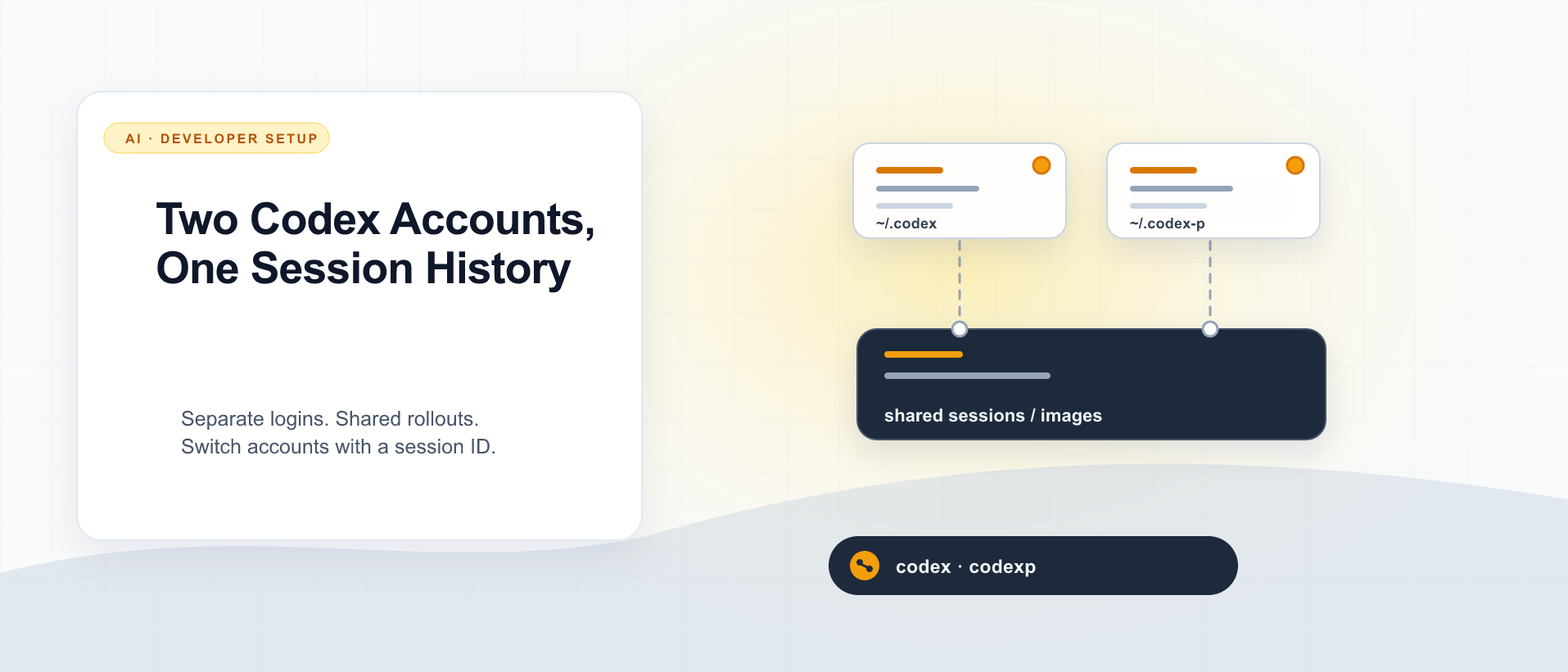
Two Codex Accounts, One Session History
Use CODEX_HOME for a second Codex login, then share only the session files you need to resume by ID. Here is the setup I use, what stays separate, and what I actually verified.
I Tuned My Local AI Server. Then I Tried Ollama.
Vulkan, Flash Attention, speculative decoding, thread counts, and a custom service. After all that tuning, Ollama matched or slightly beat my Qwen3.8 setup on the same mini PC.
What did you take away?
Thoughts, pushback, or a story of your own? Drop a reply below — I read every one.
Comments are powered by Disqus. By posting you agree to theirterms.