Seeing My Listening: Spindle Stats and a Yearly Recap for Navidrome
Top artists, a listening clock and a yearly Wrapped-style recap, built from my own Navidrome plays. How Spindle collects them, what it took to deploy, and what its numbers can and cannot tell me.
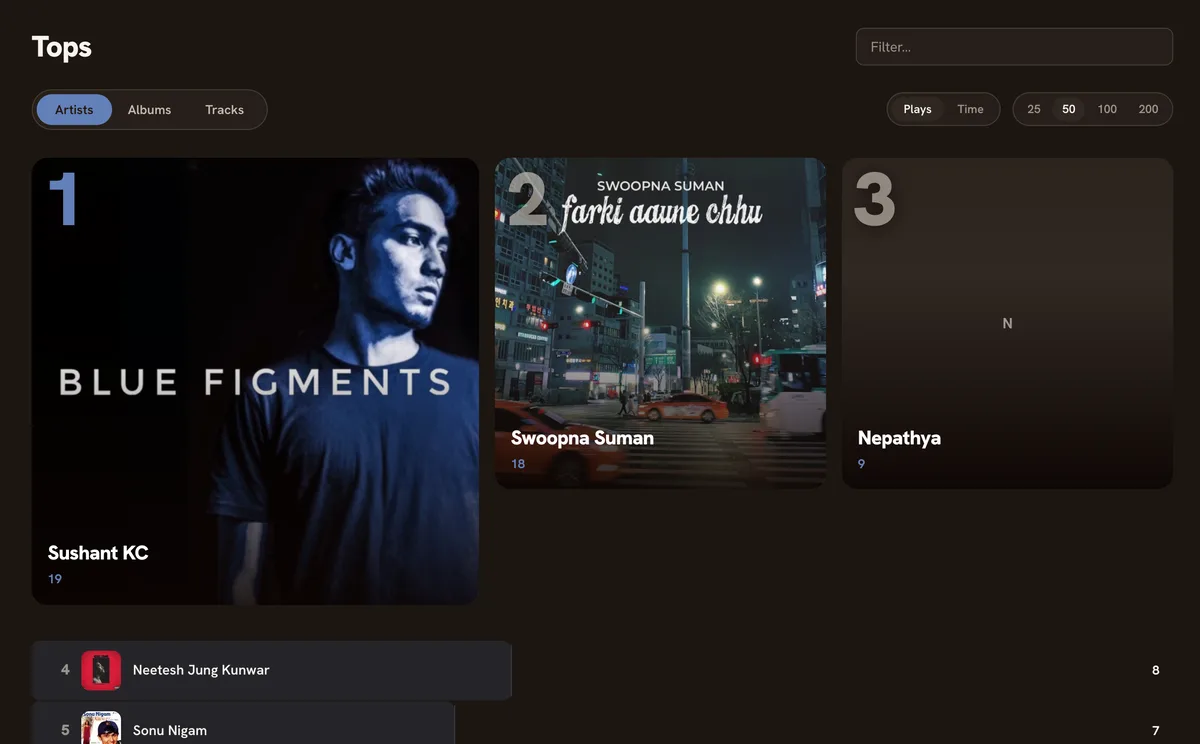
One of the fun parts of a streaming app is the end-of-year recap: who you played most, your biggest day, the hour you always reach for music. Owning my library should not mean giving that up. Spindle, an open-source project on GitHub, gives me those stats from my own Navidrome plays, on my own server.
What it shows me
Spindle is a small dashboard: a backend that stores play events and a web interface that turns them into views. The ones I actually open:
- Home — totals for the selected range and the top artist. Over the last 30 days that was 293 songs, about 24 hours of listening, 165 artists and 211 albums.
- Tops — ranked artists, albums and tracks, by plays or by time.
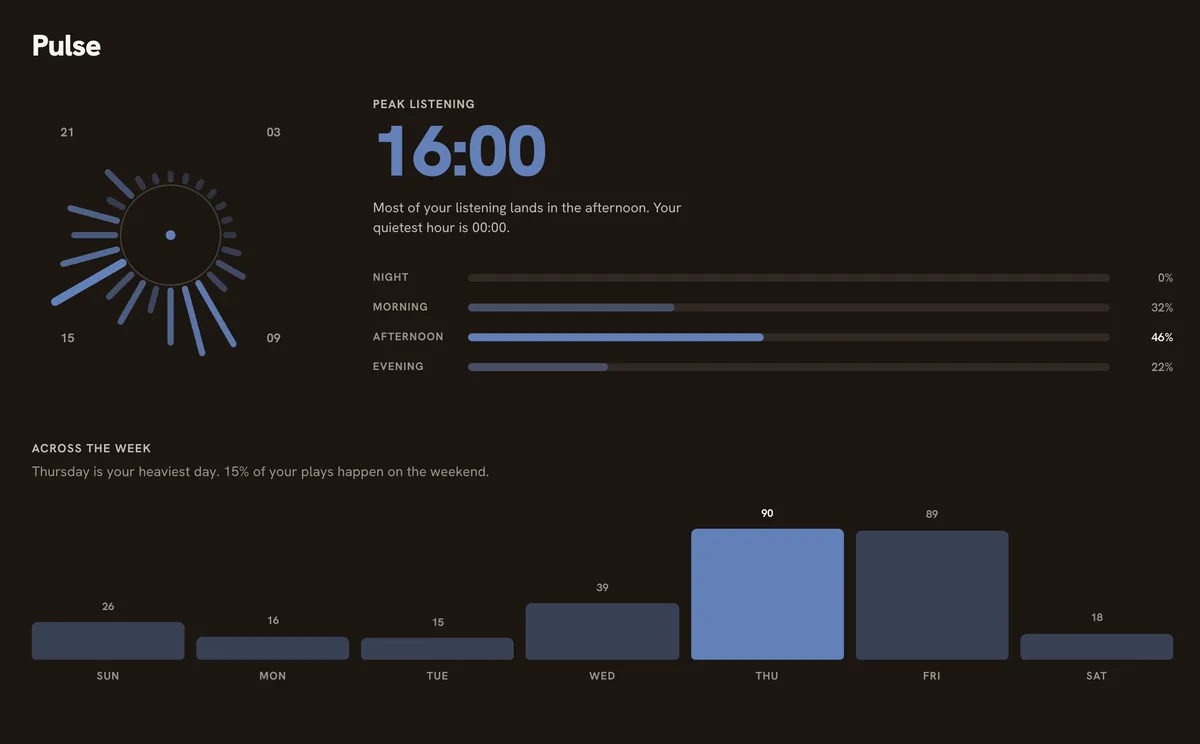
- Pulse — a listening clock and a weekday chart. For the last 30 days my peak hour is 16:00, Thursday is my heaviest day, and 15% of my plays fall on the weekend.
- Flow — how the artists I play shift from week to week.
- Sessions — runs of continuous listening, with the track that started each one.
- Wrapped — the yearly recap, built from the same events.
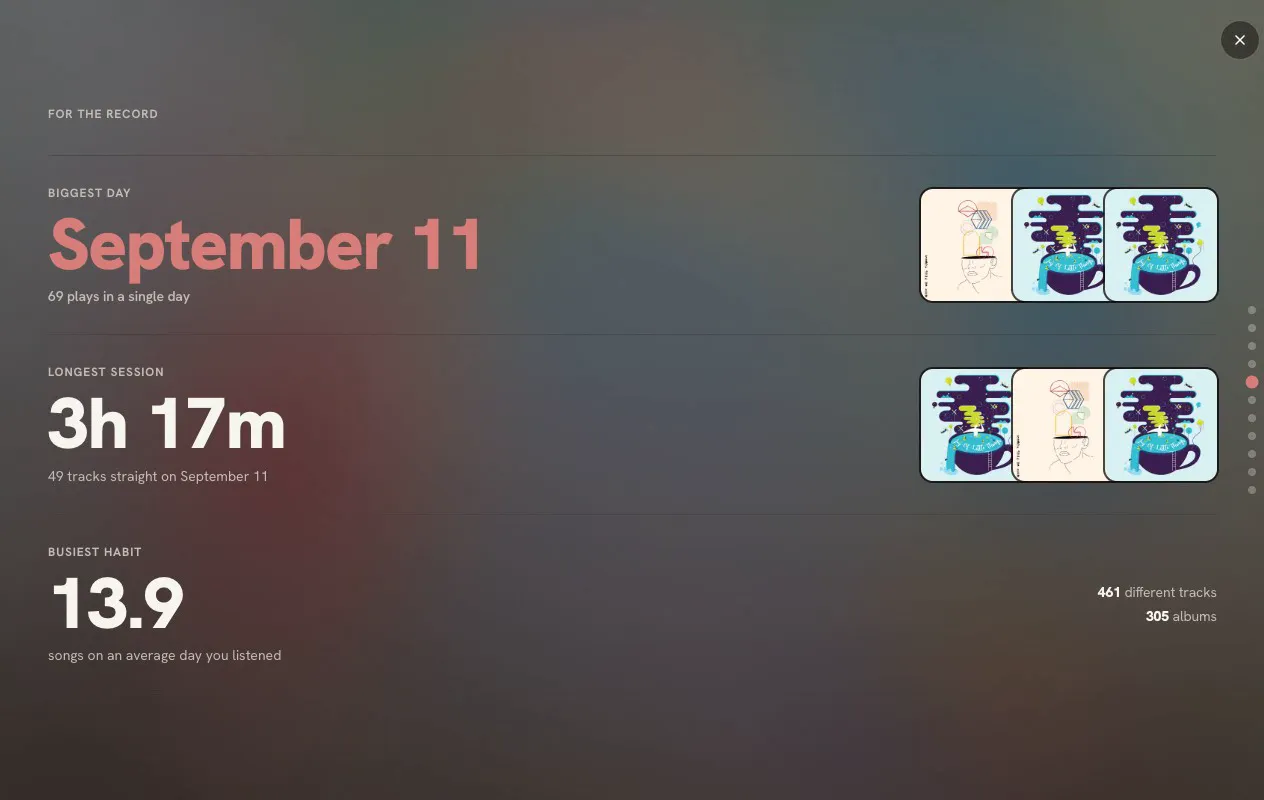
Wrapped is the part that makes it feel like a streaming service. Mine says the year peaked on 11 September: 69 plays in a single day, including a 3-hour 17-minute session of 49 tracks. On an average day that I listened at all, I played 13.9 songs.
How plays reach it
Spindle has two halves. A collector plugin runs inside Navidrome and posts each scrobble to the Spindle backend. The backend keeps its own SQLite event store and reads Navidrome’s database for album, artist and cover-art details. The dashboard reads only from Spindle.
Navidrome play ──► collector plugin ──► Spindle backend (SQLite events)
                                              │
              navidrome.db (metadata, art) ───┘──► dashboard
That makes Spindle a sibling of the ListenBrainz scrobbling I already had, not a replacement. ListenBrainz holds my long-term history and feeds recommendations; Spindle is the local, visual view of what I played.
Deploying it
I run Spindle 0.4.3 as a Docker Compose service on the same host as Navidrome, behind its own Compose profile so a routine update of the media stack does not start it by accident. Caddy serves it at a local hostname that only trusted networks can reach, and the container exposes no host port. Deployment is an Ansible playbook that runs read-only checks first and stops unless I confirm.
Four things were less obvious than I expected:
- The collector has no ready-made download. The collector is part of
the Spindle project on GitHub: a small plugin that runs inside Navidrome
and sends each play to Spindle. Its releases include only the source code,
so a coding agent compiled the unchanged v0.4.3 source to WebAssembly
(
wasm32-wasip1) for Navidrome, and my deploy playbook pins the result by checksum. - Plugin permissions use user IDs, not usernames. Navidrome accepted a username in the plugin’s user list without complaint, and the collector then silently failed its permission check. Selecting users in the web UI avoids that.
- The Navidrome data folder is mounted read-write. Spindle opens the database read-only, but SQLite still manages its write-ahead log files next to it, and a read-only mount can fail to open the database or return stale data.
- One password guards everyone’s history. The dashboard has a single shared passphrase, not per-user accounts. That is fine on a home network for one listener; it is not something I would expose to the internet.
The collector’s manifest also requests HTTP access to any host, the same broad scope I accepted for the AudioMuse plugin. Navidrome runs plugins in a WebAssembly sandbox and the target is the backend URL I configure, but I review that permission again on every plugin upgrade.
Bringing in older plays
A dashboard that starts on install day is empty for months. Spindle can import history from ListenBrainz and Last.fm, so I imported mine. The importer keeps only plays whose artist and title match a track in my library exactly, and removes duplicates by track and timestamp.
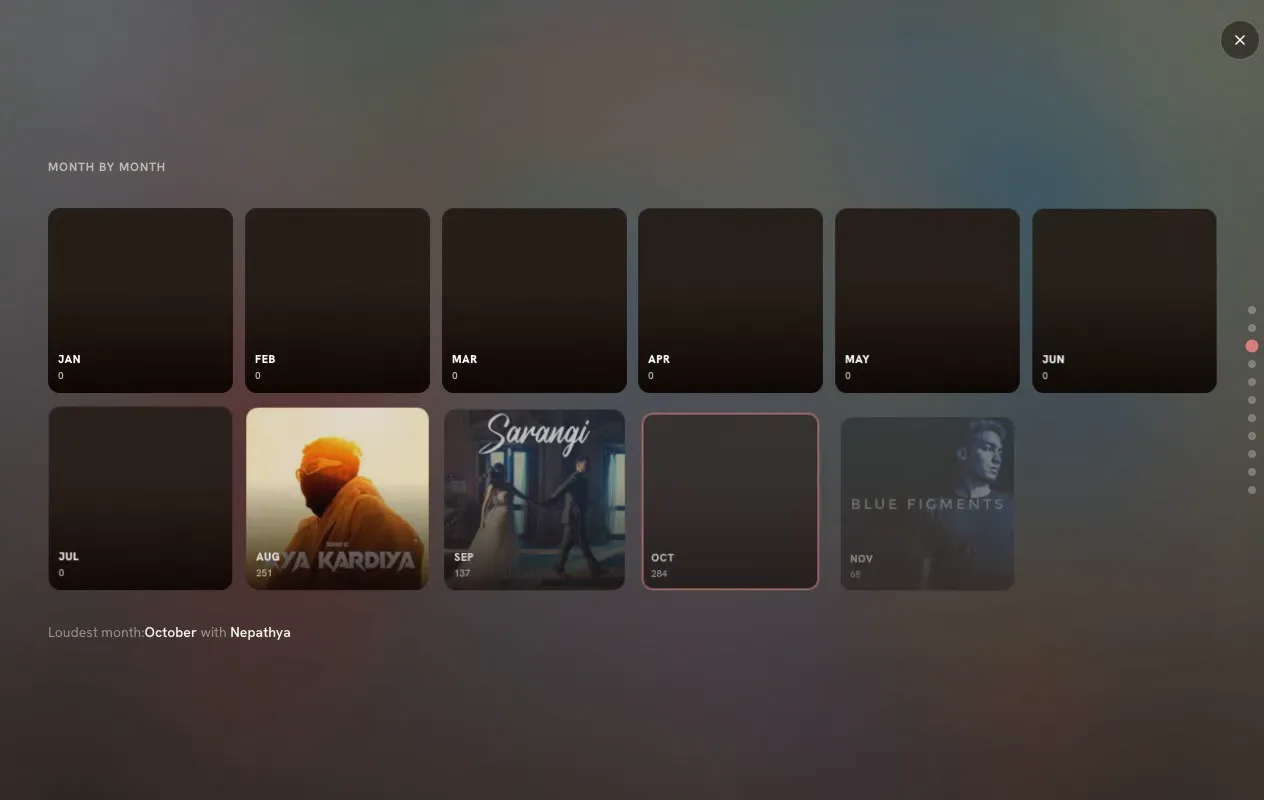
Some imported counts arrive as totals with no dates. Spindle keeps those in the all-time numbers but cannot place them on a timeline, so the time charts and Wrapped only start where dated plays begin. In my recap, January to July are empty and the year effectively starts on 11 August: 737 plays across 84 days, with October as the loudest month.
Plays on my offline iPod never pass through Navidrome, so the collector does not see them. They reach ListenBrainz through the importer described in the scrobbling guide. Spindle would only pick them up through another import from ListenBrainz.
What the numbers are good for
Spindle tells me what I played, not what I liked. A song can top the chart because it sat in a long playlist, and an album I love can barely register if I mostly play it offline. Imported history without dates widens the gap between the all-time totals and the charts.
Read with that in mind, it does what I wanted: a quick, honest look at my own listening, and a yearly recap that comes from my library rather than a subscription. Keeping that kind of fun was the point of running my own music stack in the first place.
Sources

Running My Own Music Stack
7 parts in this series.
A self-hosted music setup with no subscription that keeps the fun parts of streaming: finding new songs, sounds-like-this mixes, listening stats and music that goes offline. Part 1 explains why I left Spotify; the rest are the build guides for a lossless library, Navidrome, AudioMuse, ListenBrainz, Spindle stats and a Rockbox iPod.
- 01My Music After Spotify: Discovery, Ownership and an Offline iPod
- 02Building a Lossless Music Library You Own
- 03The iPod as an Offline Music Player: Rockbox, Flash Storage and Playlist Sync
- 04Keeping Your Listening History: ListenBrainz for Navidrome and an Offline iPod
- 05Finding Similar Songs with AI: AudioMuse and Navidromeprevious
- 06Seeing My Listening: Spindle Stats and a Yearly Recap for Navidrome← you are here
- 07My Everyday Music Workflow, Without a Subscriptionup next
What did you take away?
Thoughts, pushback, or a story of your own? Drop a reply below — I read every one.
Comments are powered by Disqus. By posting you agree to theirterms.