IEM Fit, Eartips and Cables: What to Check
Checking seal, comfort, tip choice and cable compatibility without promising a fixed sound improvement.
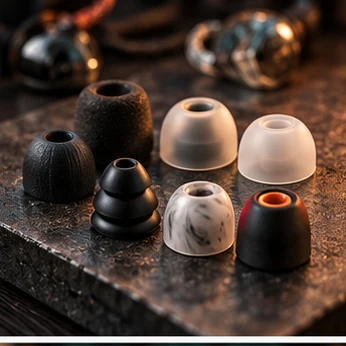
Two people can buy the same IEM and describe it differently. One calls it neutral, the other thin. Often the IEM is fine and the fit is not. Before spending on a new source or cable, get the seal right. A poor seal is worth checking before buying more equipment.
Seal is bass
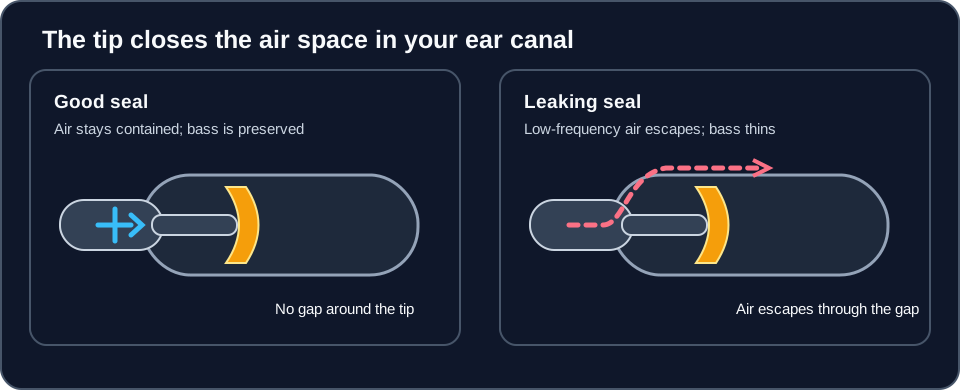
An IEM makes bass by moving air in a small, closed space: the ear canal sealed off by the eartip. If air leaks out around the tip, low frequencies leak with it. Mids and treble barely change, so the IEM sounds bright and lean rather than obviously broken.
Signs of a poor seal:
- Bass is weak, and pressing the IEM gently into your ear makes it fuller.
- Outside noise is loud with music paused.
- The sound changes when you chew, talk or turn your head.
- One side sounds bassier than the other.
The graphs from the previous part on frequency response assume a perfect seal. If your fit leaks, no graph describes what you hear.
Insertion depth
How deep the tip sits changes more than bass. The ear canal resonates, and pushing an IEM deeper shortens the air space between the nozzle and your eardrum. That moves treble peaks around, mostly above about 5 kHz. A shallow fit can make an IEM sound peaky or sibilant; a slightly deeper one can smooth it, or the reverse.
Two practical points:
- Find a consistent depth. Pull the top of your ear up and back as you insert, then let go. Same motion every time.
- Do not judge treble from one fitting. Reseat and listen again before deciding an IEM is harsh.
Tip types
Silicone, foam and flanged tips offer different shapes and feel. Their effect depends on the nozzle, insertion depth and your ears. I would not promise a fixed bass or treble change from material or bore width alone.
Start with the supplied tips. Try sizes separately for each ear, and compare with music you know at the same comfortable volume. A stable seal matters more than the label on the packet.
Sizing
Most IEMs ship small, medium and large tips. Most people try medium and stop there.
- Try the next size up. A larger tip often seals better and is still comfortable.
- Size each ear separately. Ear canals are rarely identical. Different sizes left and right are normal.
- Use a seal test. Play a track with steady deep bass, then insert and remove the tip slowly. The fullest point is your seal.
- Stop if it hurts. Try another size or shape rather than forcing the fit.
A painful fit needs changing. Comfort counts: a slightly smaller tip you wear all day beats a perfect seal you remove after an hour.
Cables and 4.4 mm balanced
Many current IEMs use detachable cables, often with swappable plugs. The Crinear Daybreak I am considering, for example, comes with 3.5 mm and 4.4 mm plugs.
| Connection | What it is | Where it helps |
|---|---|---|
| 3.5 mm single-ended | Left, right and a shared ground | Works with everything, including the iPod Video |
| 4.4 mm balanced (Pentaconn) | Separate driven connections for each channel | Sources with a balanced output, such as higher-end Sony Walkmans and many DAC dongles |
A balanced output drives each earpiece with its own amplifier pair. On sources that have one, it often offers more power and better channel separation than the same player’s single-ended jack. Whether that is audible depends on the source and IEM; with efficient IEMs it may not be.
So the rule is narrow: a 4.4 mm cable matters only if your source has a 4.4 mm output. The iPod Video 5.5G has one 3.5 mm headphone jack, so a balanced cable does nothing there. On a Walkman with a balanced port, it is worth trying, ideally with the cable or plug that came with the IEM.
Replacing a cable
Choose a replacement for connector compatibility, comfort, durability, length or handling noise. Cable resistance can matter with some low-impedance earphones, but the metal’s name alone does not establish a sound improvement. See source and load impedance before treating a cable as a tuning tool.
A fit routine
- Start with the stock silicone tips, the size that seals without pain.
- Do the bass seal test for each ear.
- Reseat a few times and listen for consistent treble.
- If the bass is still light, try foam or narrow bore before reaching for an equaliser.
- Change one thing at a time and listen to music you know.
With fit sorted, the next part turns to sources: DAC dongles, digital audio players and why output impedance matters.
Sources

Headphones and Digital Audio: Reference Notes
7 parts in this series.
Concise references on audio formats, headphone tuning, fit, measurements and source compatibility. Price snapshots and buying shortlists are dated separately from the guides.
- 01What You Can Actually Hear: Sample Rate, Bit Depth and Bitrate
- 02Sound Signatures Explained: Neutral, Harman, Warm, V-Shape and the Rest
- 03Reading a Frequency-Response Graph: Targets, Ear Gain and Why Measurements Disagree
- 04IEM Drivers, Impedance and Choosing by Signatureprevious
- 05IEM Fit, Eartips and Cables: What to Check← you are here
- 06DACs, Music Players and Output Impedanceup next
- 07iPod or Sony Walkman: Features, IEM Pairing and Buying Choices
What did you take away?
Thoughts, pushback, or a story of your own? Drop a reply below — I read every one.
Comments are powered by Disqus. By posting you agree to theirterms.