Series
The Product Context Repo
A six-part build-along: a git-based knowledge repo for product work, the structure that lets both agents and humans navigate it, a signal pipeline that turns support tickets, call transcripts, and CRM notes into structured evidence, MCP connections to your tracker, docs, and chat, commands that draft user stories and PRDs from the repo, and the editorial discipline that keeps AI slop out of your backlog.
6 parts · first published
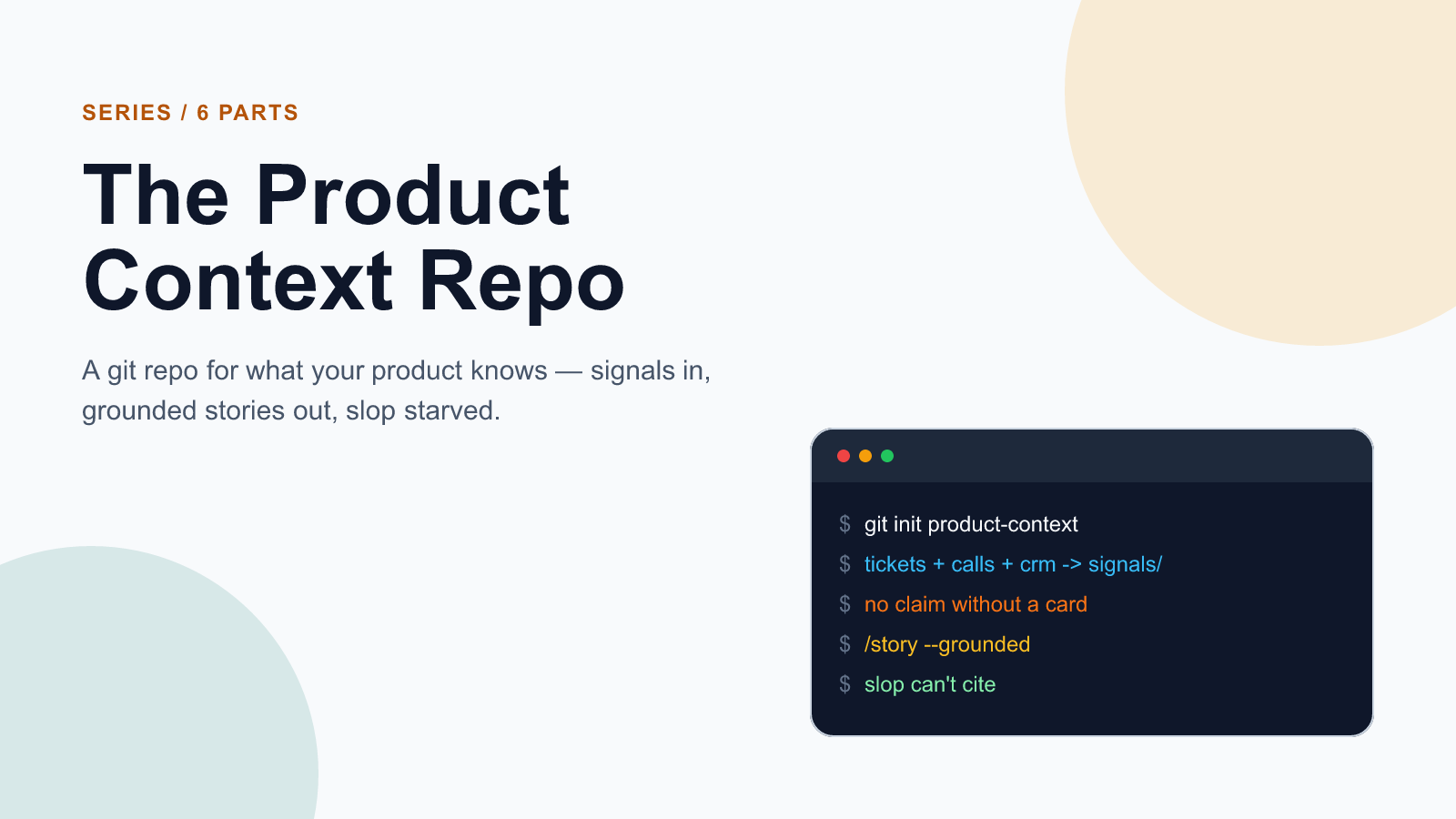
- 01
The Product Context Repo: Why Your Product Knowledge Belongs in Git
Every AI tool you point at your backlog produces confident, generic garbage — not because the model is weak, but because it has never met your product. The fix isn't a better prompt. It's a repo: a plain-text, version-controlled home for everything your product knows about itself, structured so both humans and agents can read it. Part one of a six-part build-along.
·7 min read - 02
Designing the Context Repo: a Structure Agents and Humans Can Navigate
The difference between a context repo that compounds and one that rots is decided in the first week, by structure: small files that answer one question each, frontmatter that makes them queryable, decision records with dates, and an AGENTS.md that teaches AI tools how to read the whole thing. The complete layout, with copy-paste starter files.
·6 min read - 03
The Signal Pipeline: Tickets, Calls, and CRM into One Weekly Digest
Customer evidence is the most valuable input a product team has and the worst-managed: tickets in the help desk, transcripts in the call recorder, lost reasons in the CRM, all unread past week one. This post builds the pipeline — a signal card format, a per-source extraction pass, and a one-hour weekly ritual that turns raw exhaust into evidence your stories can cite.
·6 min read - 04
Connecting the Tools: Tracker, Docs, and Chat Without Drowning in Integrations
The repo holds context and the tracker holds work — but your AI assistant needs to reach both in the same session, plus the docs where specs get collaborated on and the chat where decisions actually happen. This post wires it: MCP connections to Jira/Linear, Notion/Confluence, and Slack/Teams, the read/write rules that prevent a sync monster, and the permission boundaries you set before connecting anything.
·6 min read - 05
Commands That Write User Stories and PRDs with Real Context
A prompt you retype is a workflow you can't improve. This post turns the repo's two highest-frequency jobs — drafting user stories and drafting PRDs — into versioned command files: what context they load, what questions they must ask, what format they emit, and the guardrails that make their output reviewable instead of just plausible. Full command files included, copy-paste ready.
·6 min read - 06
Avoiding AI Slop: Writing User Stories a Team Will Actually Build
AI slop in a backlog is worse than an empty backlog, because it's plausible enough to survive triage and hollow enough to fail in sprint. The series finale: how to recognize slop in product artifacts, the grounding rules that starve it, and the user-story craft — INVEST, vertical slices, testable criteria — that matters more now that drafting is free and judgment is the bottleneck.
·6 min read