Series
The Product Operating Rhythm
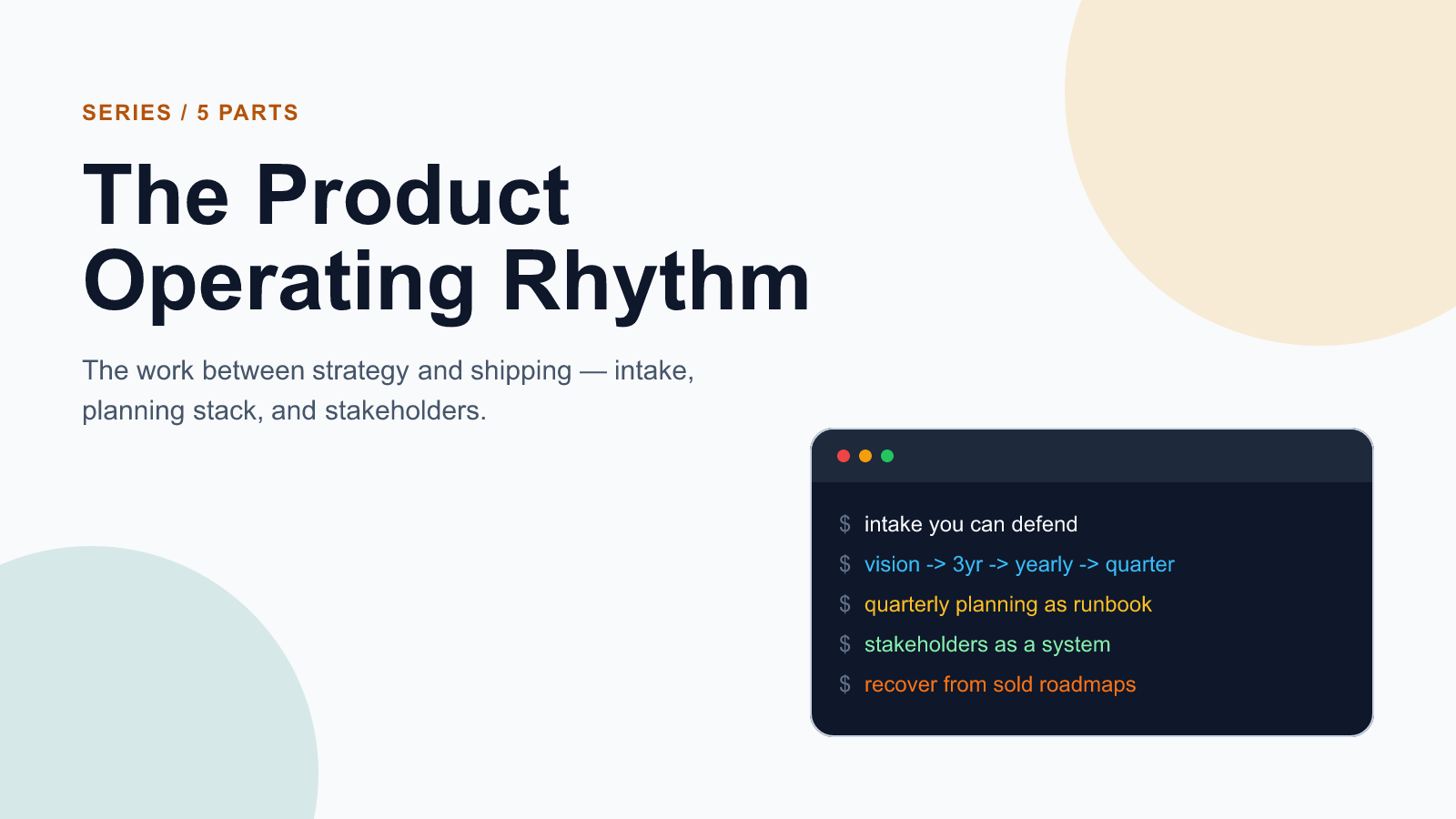
A five-part series on the work between strategy and shipping — a customer-request intake you can defend, the planning stack from undated vision through 5-year, 3-year, yearly, and quarterly plans without repeating yourself, the quarterly planning ritual as a runbook, stakeholder management as a system a product owner runs, and the recovery playbook for when sales sells a feature that was never on the roadmap.
8 parts · first published
- 01
Before You Write an OKR — OKRs vs. Rocks vs. a Bare North Star
Three goal-setting systems, each claiming to be the best — and all three are right, for different organizations at different stages, which is why the real skill isn't writing OKRs but knowing which framework your team actually needs.
·8 min read - 02
Handling Customer Requests: An Intake You Can Defend
The backlog where customer requests go to die isn't a filing problem — it's a decision problem wearing a filing costume. Here's the intake pipeline I actually run: one ledger, five interrogation questions, clustering by problem instead of by feature, and the exact wording of a no that builds more trust than a silent maybe.
·13 min read - 03
The Planning Stack: Vision to Quarter Without Repeating Yourself
Most companies' 1/3/5-year plans are the same slide deck at three zoom levels — the annual plan is the quarterly plan times four, the 3-year plan is the annual plan with bigger numbers. That repetition is the tell that no planning happened at the longer horizons. Here's the fix: five documents, five different questions, and the smell test that reveals when each one is fake.
·13 min read - 04
Cascading OKRs to Department and Product Without a Status Report
Most OKR cascades are arithmetic disguised as alignment — the company KR divided by headcount becomes every team's KR, and nobody notices that no actual thinking happened between the layers.
·7 min read - 05
Running Quarterly Planning Without Losing the Quarter
The worst quarterly planning I ever ran took three weeks, produced a beautiful deck, and changed nothing. The best took two, ended before the quarter started, and the plan survived to week twelve. Here's the runbook: the four input docs, the three sessions, the 70/30 commitment split, and the in-quarter cadence that keeps the plan alive without re-litigating it every sprint.
·14 min read - 06
The Product Owner's Stakeholder Craft: Run It as a System
The worst stakeholder blowup I've been part of wasn't caused by a bad decision — it was caused by a good decision that a VP learned about at release. Stakeholder management isn't a soft skill you improvise in the hallway; it's a system you run: a living map, a pre-wiring cadence, a decision log, an escalation contract, and a trust ledger you're always either funding or draining.
·16 min read - 07
When You Need a Dedicated BA, and When the PO Already Does This Job
A team that hired a BA too early burned six months of salary on documentation nobody read; a team that hired one too late lost a regulatory deal because requirements were scattered across Slack threads. The split point isn't team size — it's the ratio of domain complexity to product complexity.
·9 min read - 08
Sales Sold It: The Recovery Playbook for Unplanned Commitments
The contract is signed, the feature is due in eight weeks, and nobody on the product side has ever scoped it. The two obvious reflexes — bend the quarter or refuse on principle — both make the next one worse. Here's the recovery playbook: establish what was actually promised, get in front of the customer fast, price the promise for the people who own the tradeoff, and turn the whole incident into roadmap signal instead of roadmap debt.
·14 min read