Series
The Strategy Cascade
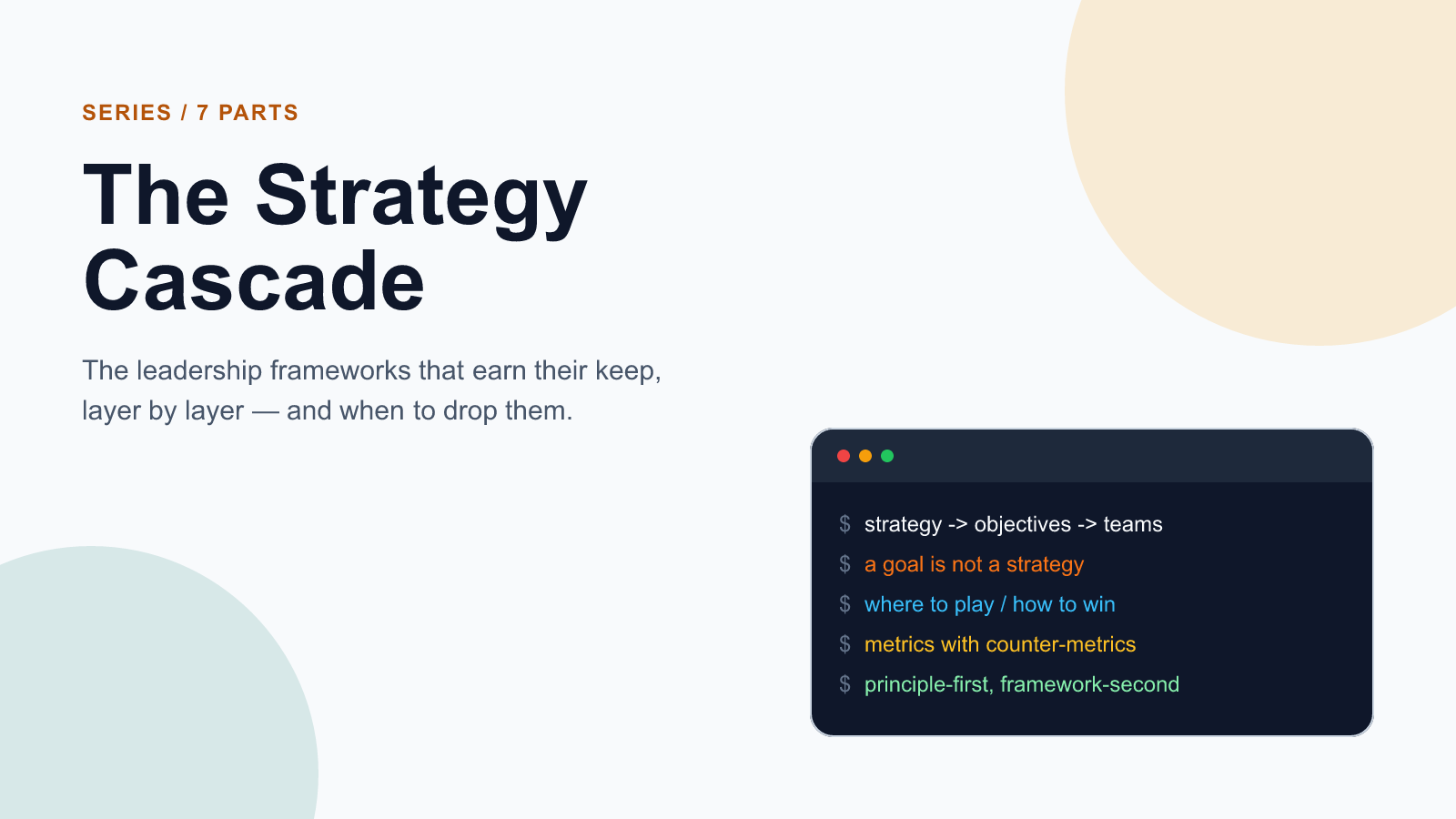
A seven-part series on the product and engineering leadership frameworks that actually earn their keep — organized by the layer of work each one serves, from strategy formation down to org design, with when-to-use guidance and real failure modes for each, closing with the case for principle-first thinking over framework collecting.
7 parts · first published
- 01
The Strategy Cascade: Frameworks I Actually Reach For
Every team I've been on has argued about priorities every single sprint. Eventually I noticed the argument was never about the backlog — it was about a missing layer above it. Here's the strategy cascade I use to find that layer, and where the rest of this series goes to work through each one.
·5 min read - 02
Strategy Formation: How to Tell a Real Strategy From a Wish
Most documents labeled 'strategy' are actually goals wearing a strategy's clothes. Here's the kernel test I run to catch that, plus the three other frameworks I reach for once diagnosis alone isn't enough — Playing to Win, Wardley Mapping, and 7 Powers.
·8 min read - 03
Discovery Frameworks That Actually Change What You Build
Objectives and roadmaps are only as good as the discovery underneath them — and most discovery I've watched happen is just feature requests wearing a lab coat. Here's the set of frameworks that actually separates a real customer problem from someone's opinion, the gate that decides whether a validated problem is worth building for, and where each one still fooled me before it earned its keep.
·12 min read - 04
Turning Strategy Into a Shippable Sequence
The roadmap and backlog layers are where every strategy either becomes real or quietly dies in a spreadsheet. Here's what I've actually learned running RICE, Cost of Delay, WSJF, and Scrum vs. Kanban vs. Shape Up against real backlogs — including where each one lied to me.
·9 min read - 05
Risk Reduction: The Vocabulary I Use Under Pressure
Most teams don't lack judgment, they lack a shared vocabulary for talking about risk before it becomes an incident. These are the six tools I actually reach for when a decision needs to be fast, reversible where it can be, and scrutinized where it can't.
·10 min read - 06
Org Design & Measurement: Closing the Strategy Loop
The layer that decides whether a strategy has any teeth at all isn't the roadmap, it's who owns what and whether the numbers you're tracking mean anything. This is the last framework post in the series, and the one where the cascade stops being a diagram and starts being an org chart.
·11 min read - 07
Principle-First: When to Put the Frameworks Down
After six posts of frameworks, here's the uncomfortable conclusion: the best product people I've worked with use fewer frameworks every year, not more. The frameworks were never the point — they're scaffolding for principles, and the goal is to reach the point where the scaffolding comes down.
·8 min read