Series
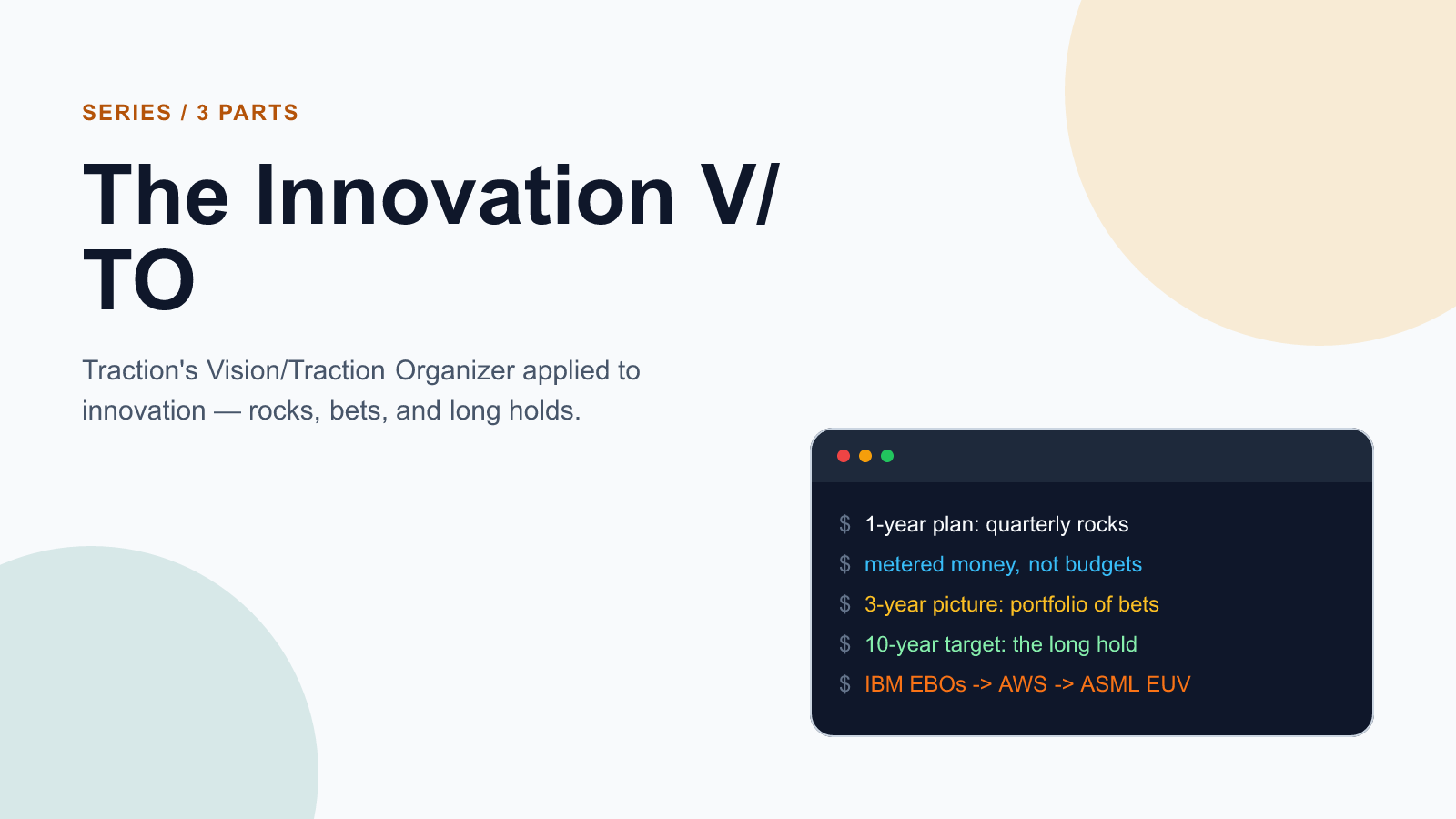
The Innovation V/TO
An eight-part series running Traction's full Vision/Traction Organizer as an innovation strategy stack, ordered by V/TO section — core values as the permission structure, core focus as the hedgehog, the ten-year target as a long bet held with institutional patience, marketing strategy as beachheads, the three-year picture as a steerable portfolio, the one-year plan as metered money, rocks as ninety-day experiment contracts, and the issues list as the machine that surfaces bad news. Referenced stories throughout: IBM's EBOs, Tesla's master plan, AWS, ASML's EUV, Apple's 1997 product cull, LEGO's near-death, the Challenger, and the Concorde fallacy.
8 parts · first published
- 01
Core Values for Innovation: The Permission Structure
The V/TO starts with core values, and innovation people roll their eyes — values are the poster in the lobby, the section everyone skips. Enron's poster said Integrity. But values are load-bearing for innovation in a way they aren't for operations: they're the permission structure that tells people what they're allowed to risk without asking. 3M's McKnight wrote the canonical one in 1948; Netflix and Amazon shipped theirs as operating documents. Here's how to write values that actually permit new bets.
·6 min read - 02
Core Focus for Innovation: The Hedgehog and the Product-Line Massacre
The V/TO's core focus — purpose plus niche — sounds like the least innovative section of the whole organizer: a fence around what you'll do. It's actually the section that makes innovation survivable, because unfocused companies innovate by accretion until the portfolio kills them. Apple's 1997 product massacre and LEGO's near-death diversification are the two best-documented cases of focus as a rescue operation — and both show that the fence is what makes the bets inside it affordable.
·6 min read - 03
The Ten-Year Target: Long Bets and Institutional Patience
Traction's ten-year target is EOS's version of the BHAG — one dated, measurable destination the whole organization can recite. Companies mostly fail it in two opposite ways: no target at all, or a target without the institutional machinery to stay committed for a decade. AWS, Apple silicon, ASML's EUV, and the Prius show what patience wired into structure looks like; Kodak, Nokia's shelved prototypes, and the Concorde fallacy show the two ways decade-bets die — under-commitment and over-commitment.
·7 min read - 04
Marketing Strategy for Innovation: Beachheads and The List
The V/TO's oddest section is a marketing strategy inside a vision document — a target-market List, three uniques, a proven process, a guarantee. For innovation it's the section that prevents the most expensive mistake there is: building for 'the market' instead of a named beachhead. Moore's chasm, Tesla's rich-people-first sequencing, Facebook's campus-by-campus rollout, and Superhuman's 40% test are all the same discipline — and Startup Genome's data says its absence is the leading cause of death.
·6 min read - 05
The Three-Year Picture: An Innovation Portfolio You Can Steer
Traction's three-year picture is deliberately not a plan — it's a described destination, revisited yearly, that the one-year plan navigates toward. Applied to innovation, that's exactly what a portfolio of bets needs: a painted picture of the business you're becoming, a set of options priced accordingly, and the discipline to sequence them so each bet funds the next. IBM's EBO program, Tesla's four-line master plan, and Netflix's three-act pivot show what steerable looks like.
·7 min read - 06
The One-Year Innovation Plan: Rocks, Metered Money, and a Kill Cadence
Annual planning is where corporate innovation goes to die — twelve months of projected outcomes for work whose defining property is that outcomes can't be projected. Traction's answer is to plan the year as a small set of quarterly rocks; the innovation literature's answer is to fund assumptions, not roadmaps. Put together, they make a one-year innovation plan that survives contact with reality: fewer commitments, metered money, a weekly scorecard that counts learning, and a standing appointment to kill things.
·8 min read - 07
Rocks for Innovation: The Ninety-Day Experiment Contract
Rocks are the V/TO's smallest unit — three to seven quarterly priorities, each owned by one person, each simply on-track or off-track at the weekly meeting. The one-year plan post covered how rocks get funded; this one covers how they get written and run when the work is an experiment: the rock as a contract about evidence rather than delivery, why the binary status check beats status theater, what OKR grading gets right that rocks should steal, and Parkinson's law as the real argument for ninety days.
·5 min read - 08
The Issues List for Innovation: Surfacing Bad News at Line Speed
The V/TO ends with its humblest artifact — the issues list, a running inventory of everything wrong, unresolved, or unsaid, worked weekly through Identify-Discuss-Solve. For innovation it's the load-bearing page: new bets die of suppressed bad news, from the Challenger's normalized O-ring anomalies to every zombie project whose doubts never made it onto an agenda. Toyota's andon cord, Grove's revolving-door question, and Google's Project Aristotle are all versions of the same machine — one that makes bad news cheap to say and expensive to sit on.
·6 min read