Series
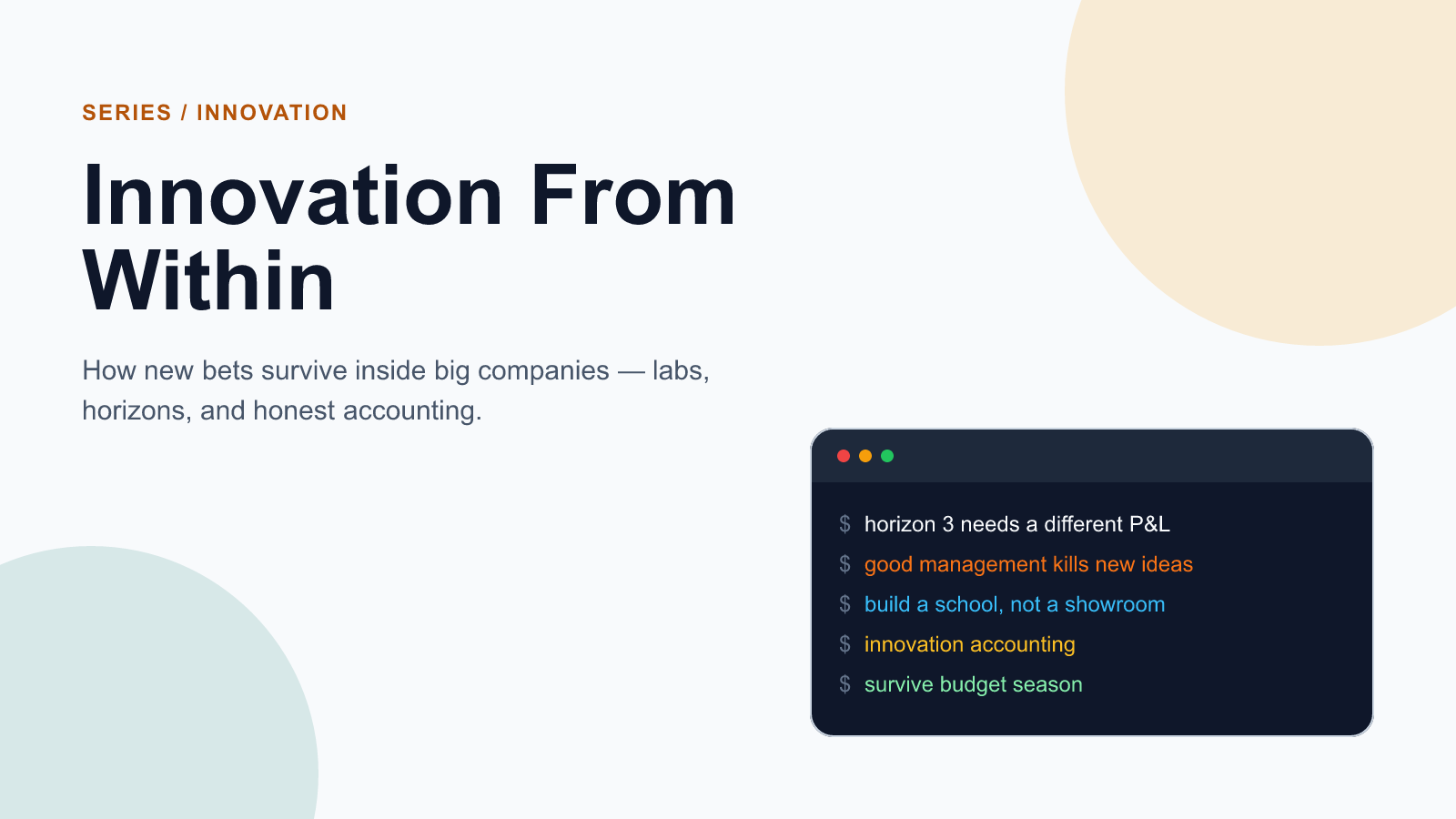
Innovation From Within
A ten-part series on how innovation actually happens inside big companies — why good management rationally kills new ideas (the Innovator's Dilemma), where new bets should live (Three Horizons, the ambidextrous organization), labs that compound, real intrapreneurship (Kickbox, 15% time), innovation accounting, and then the outside game: spin-outs and sister companies, corporate venture capital, backing the right startups in a power-law world, pricing new ventures, and managing runway.
10 parts · first published
- 01
Why Good Companies Kill Good Ideas
Kodak built the first digital camera in 1975. Blockbuster's management proposed the Netflix-killing strategy in 2004. Neither company was blind, and that's the uncomfortable part: the ideas died because good managers, doing exactly what good management prescribes, rationally killed them. Christensen's Innovator's Dilemma is a structural diagnosis, not a culture complaint — which means the fixes have to be structural too.
·13 min read - 02
Three Horizons and the Ambidextrous Organization: Where New Bets Should Live
The two most-cited frameworks for structuring innovation inside a big company are both routinely used wrong. Three Horizons was a portfolio-attention tool that got corrupted into a delivery timeline — and Steve Blank has argued the timeline reading is now actively dangerous. Ambidexterity has a 35-project evidence base almost nobody reads past the diagram. Here's what each actually says, where each breaks, and how to decide where a given bet should live.
·13 min read - 03
How to Run an Innovation Lab: Build a School, Not a Showroom
Most innovation labs are showrooms — beanbags, a wall of Post-its, a shutdown announcement three years later. The ones that work are schools: places where people deliberately practice the craft of taking an idea from hunch to evidence, inside a structure the parent company can actually absorb. Here's the hands-on version — the pedagogy, the operating cadence, the governance, and the stories from Skunk Works to Kickbox worth stealing from.
·13 min read - 04
Intrapreneurship: Kickbox, 15% Time, and the Myth of the Corporate Rebel
The Post-it note took twelve years, Google's 20% time quietly died of manager incentives, and the heroic corporate rebel is mostly survivorship bias — we only hear from the ones who weren't fired. What actually produces innovation from within isn't rebellious personalities. It's systems that make permission cheap and evidence mandatory: slack-time policies, a $1,000 card in a red box, and a real venture path instead of a suggestion box.
·11 min read - 05
Innovation Accounting: Funding What Doesn't Fit a P&L
You can build the separate unit, the lab, the intrapreneur program — and watch all of it die in a single budget meeting, because someone asked a two-quarter-old venture for its ROI. The immune system that kills good ideas doesn't always look like a hostile VP. Sometimes it looks like a spreadsheet, applied honestly, by people doing their jobs. Here's the financial machinery that funds new bets without lying about them.
·13 min read - 06
Innovation by Spin-Out: The Sister-Company Play
Nestlé didn't incubate Nespresso — it exiled it. Separate company, separate CEO, separate headquarters, a sales channel that violated everything Nestlé knew about selling coffee, and nearly two decades of patience before it became a pillar. Sometimes an internal unit, however protected, isn't separation enough: the new business's economics are so hostile to the parent's that the bet needs its own company. Here's when to make that call, what a real spin-out requires, and the case histories — Nespresso, Alphabet's Other Bets, Cisco's strange spin-in machine — that the pop versions get wrong.
·12 min read - 07
Corporate Venture Capital: Innovation as Investor
Fred Wilson stood on a stage in 2016 and called corporate investing 'dumb' — and for most corporate venture funds, he was right. But GV, Salesforce Ventures, and Intel Capital keep proving the exception, and the difference isn't intent, it's structure. CVC done well isn't a growth engine; it's a sensing instrument — bought optionality on futures you can't build internally. Here's Chesbrough's map of when it works, the design choices that decide it, and the boom-bust history everyone forgets between booms.
·14 min read - 08
How to Back the Right Startup: Picking in a Power-Law World
Venture returns follow a power law: a handful of deals produce most of the money, and half of everything you back goes roughly to zero. That single fact inverts every risk instinct a corporation has spent decades perfecting — because in venture, the expensive mistake isn't the startup that failed, it's the outlier you screened out for looking weird. Here's what the evidence actually says about picking: timing, teams, markets, and the anti-portfolio discipline of studying your misses.
·12 min read - 09
Pricing Strategy for New Ventures: Price Before You Build
Roughly 72% of new products miss their revenue targets, and the cause usually isn't the product — it's that nobody asked what anyone would pay until the thing was already built. Simon-Kucher's Madhavan Ramanujam calls this designing the plane and then discovering physics. Here's the discipline new ventures skip: testing willingness to pay before the roadmap exists, choosing the pricing metric before the price, and treating monetization as an experiment stream instead of a launch-week scramble.
·12 min read - 10
Runway, Burn, and the Default-Alive Question
Paul Graham found that most founders can't answer the only financial question that matters: at your current growth and burn, do you reach profitability before the money runs out? Inside corporations it's worse — internal ventures have fake runway, a budget line instead of a bank balance, and no clock at all. This closing piece of the series is about the honest clock: burn mechanics, the burn multiple, why corporate ventures need artificial scarcity, and which levers to pull, in which order, when the runway shrinks.
·12 min read