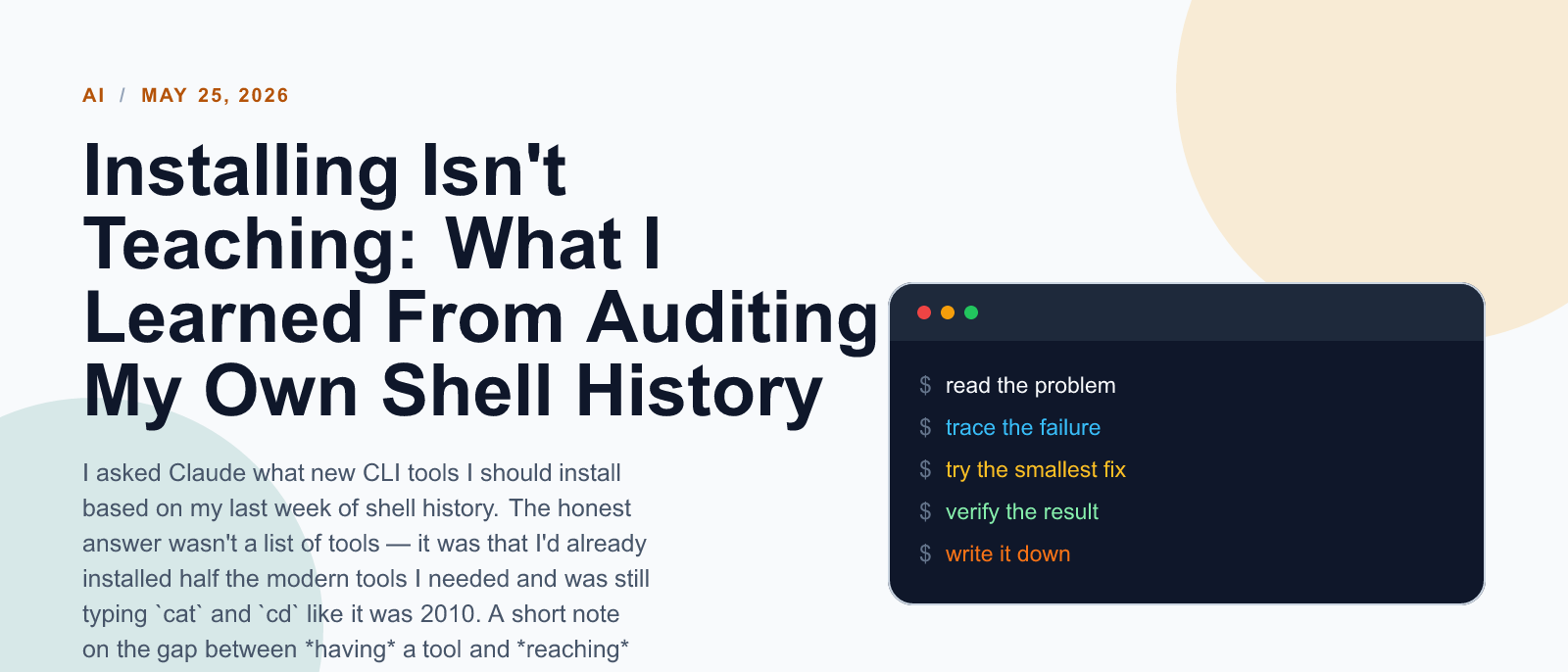
Installing Isn't Teaching: What I Learned From Auditing My Own Shell History
I asked Claude what new CLI tools I should install based on my last week of shell history. The honest answer wasn't a list of tools — it was that I'd already installed half the modern tools I needed and was still typing `cat` and `cd` like it was 2010. A short note on the gap between *having* a tool and *reaching* for one, and where that same gap shows up in your `CLAUDE.md`.
I asked Claude a question I’ve been meaning to ask for months.
“Based on my past week’s usage, what other CLI tools should I install for ease of workflow?”
I’d been adding to ~/cli-tools.md for two years. eza, bat, zoxide, fd, ripgrep, atuin, delta, fzf — the whole “modern Unix” replacement set, plus the agent-stack tools I’d added in the last six months. The file had crossed three hundred lines. I expected Claude to point at something obvious I’d missed.
It started by running atuin search --after "1 week ago" and counting my command frequencies. Here is what it found:
126 git 116 cd 31 ls 23 cat 18 glow 15 mise … 6 nano
I had bat installed. I had used cat twenty-three times.
I had eza installed. I had used ls thirty-one times.
I had zoxide installed. I had used z exactly once across one hundred and sixteen directory changes.
I had nvim installed. I had reached for nano six times.
Claude listed three new tools worth installing — killport, sd, gitleaks — and they were all good calls. But the most useful part of the answer wasn’t the new-tools section. It was a section titled, with surgical politeness, “Habit gaps (tools you have but don’t use).”
I sat with that for a minute.
The cost of installing
There’s a particular kind of dopamine in installing a new CLI tool. You read a thread about how eza --git -l shows you per-file git status; you run brew install eza; you feel like a more serious person. The next time you open a terminal, you type ls.
This is not a discipline failure. It’s a teaching failure. You taught yourself that eza exists. You did not teach yourself to reach for it.
The reach is the whole game. A tool you have installed but don’t invoke is identical, from your shell’s perspective, to a tool you don’t have at all. The bytes on disk are doing nothing. The mention in cli-tools.md is doing nothing. The screenshot you saved when you first heard of it is doing nothing. Every cat you type past the install date is a tax you’re paying for the fantasy of having upgraded your workflow.
The most expensive layer of any tooling stack is the human layer. We are very slow to update.
The fix isn’t more tools
When I saw the audit, my first instinct was to ask Claude to alias cat to bat, ls to eza, cd to z. The reasonable, two-minute fix. Done.
I said no to most of it.
Not because the aliases would have been wrong — they would have worked. But because I’d just been handed a piece of feedback that was more interesting than the immediate ergonomic win. The aliases would have covered up the audit. Six months from now, my ~/cli-tools.md would have grown another fifty lines, my ~/.zshrc would have another twenty aliases, and I would have no idea which of those tools I was actually using versus which I had installed and forgotten and aliased over so I’d at least seem to be using them.
I kept the aliases off for cat, ls, nano. I installed the three new tools. And I made one other change that turned out to matter more than any of it.
The Claude version of the same problem
After the install, I asked Claude something that, in retrospect, was the actual point of the whole exercise.
“Will you use any of these proactively?”
The honest answer was no. Not reliably. Each Claude Code session starts fresh. It doesn’t auto-read ~/cli-tools.md. It only reaches for a tool if (a) that tool is mentioned in a CLAUDE.md that loads into the session, (b) it comes up in conversation, or (c) it happens to be the kind of common tool the model already knows.
I had spent the morning teaching myself about three new CLI tools. Claude had not been in the room.
This is the same bug as the cat/bat bug, scaled up to a coworker. The tools are installed. The knowledge is in a document. The document is not loaded. The reach does not happen.
The fix this time was four lines:
## Preferred CLI tools (reach for these first)

- Kill a process on a port: `killport <port>` — not `lsof -i :PORT` + `kill -9 <pid>`.
- Find/replace in a file or pipeline: `sd 'pattern' 'replacement' <file>` — not `sed -i ''` on macOS.
- Scan for secrets before committing: `gitleaks detect` — especially when staging `.env*` or auth code.
That block went into ~/.claude/CLAUDE.md — the global one, not a project one — so it loads in every Claude Code session I start on this machine, regardless of which repo I’m in. Now when Claude sees a port conflict, the cheapest path is killport. When it sees a regex-replace task in a shell pipeline, the cheapest path is sd.
I did not write a hook. I did not write a skill. I did not write a subagent. I put four lines into the document that was already going to load anyway.
The cheapest layer, again
Regular readers will recognize the shape. This is the same rule as the subagent I deleted: pick the lightest layer that catches the rule.
For my own brain, the layers go something like:
- Habit — I just reach for the tool. Free, but slow to install in the human.
- Alias —
.zshrcrewrites the old command to the new one. Fast, but hides the audit signal. - Documentation —
cli-tools.mdexists. Catches almost nothing on its own.
For Claude, the same hierarchy translates to:
- Training data — the model already knows the tool. Free, but limited to common things.
- Global
CLAUDE.md— loads in every session. Cheap, broad, no per-project setup. - Project
CLAUDE.md— loads only in this repo. Use it for repo-specific tooling. - Skills, hooks, subagents — when you actually need behavior, not just a hint.
The mistake I almost made was layer-skipping in the wrong direction. I almost wrote a skill called /use-modern-tools that would lecture the agent on which command to use. That would have been the import-organizer mistake, run back: a skill doing the job of a one-line note in CLAUDE.md.
A four-line block in the right document beats four hundred lines of skill scaffolding. The same way a habit beats an alias beats a cli-tools.md line.
The audit is the artifact
If there’s one thing I’ll keep doing after this, it isn’t killport or sd or gitleaks. Those are nice. The thing I’ll keep doing is the audit itself.
atuin search --after "1 week ago" --limit 2000 --format "{command}" \
  | awk '{print $1}' | sort | uniq -c | sort -rn | head -50
That one pipeline, run weekly, is the most honest feedback loop I have about my own workflow. It does not care what I think I’m doing. It tells me what I actually did. The tools in my history are the tools I use; the tools missing from my history are the tools I have installed but not internalized.
The same loop applies to your agent setup. Every so often, look at what Claude actually reached for over a week of work — the tool calls in your sessions, the skills it invoked, the subagents it spawned. If half the .claude/ directory never fires, that’s not a configuration; that’s a graveyard.
Installing isn’t teaching. Documenting isn’t loading. The thing in your tool inventory only counts when the reach happens.
Three new tools went into mise today. Two new aliases did not get written. Four lines went into the global CLAUDE.md. And one shell history audit became a small permanent ritual.
Minus a few habits. Plus a feedback loop. That’s the trade I’ll take.

Keep reading

Agent Config, Installed Tool, and Live Behavior Are Three Different Things
A model or workflow can be correct in source and still be absent from the installed runtime. Verify each layer before claiming it works.
Running Independent AI Research Trials
Two isolated research environments can work from the same source material while keeping their analysis independent and reviewable.
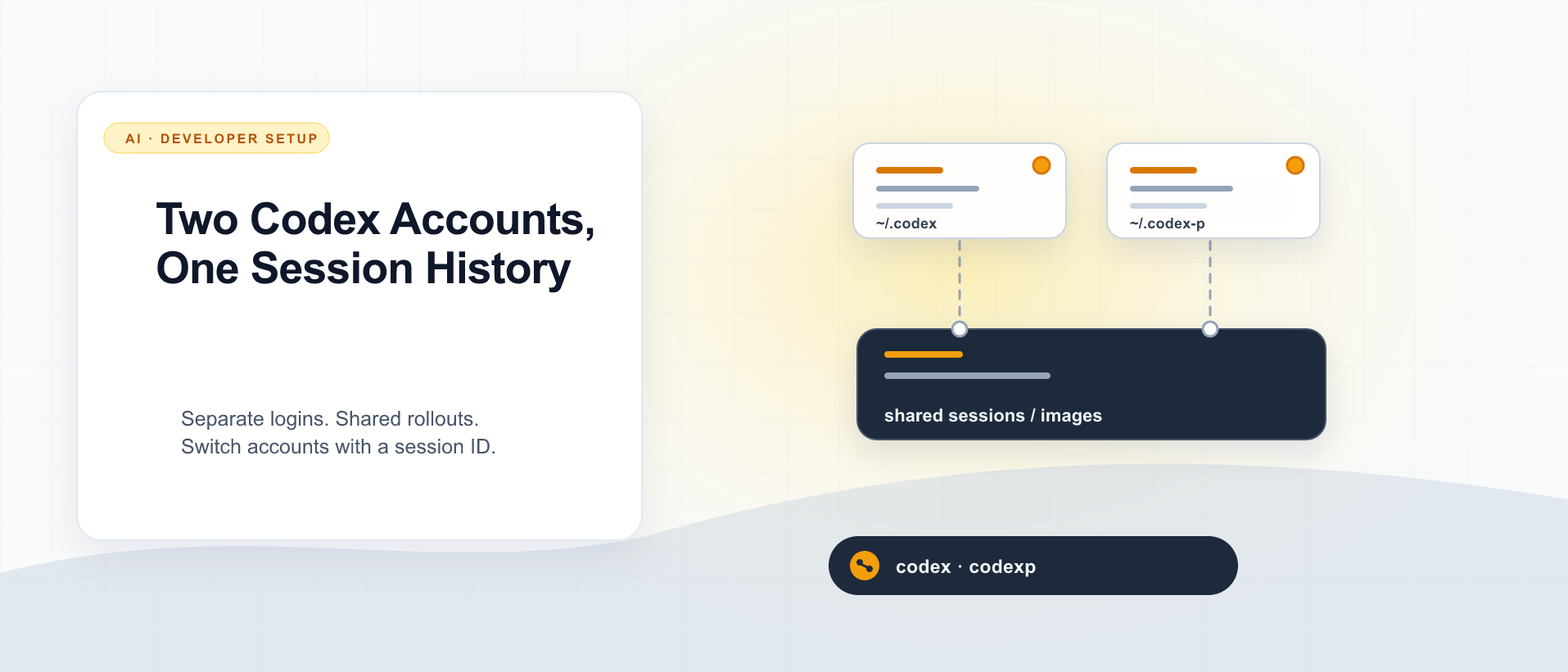
Two Codex Accounts, One Session History
Use CODEX_HOME for a second Codex login, then share only the session files you need to resume by ID. Here is the setup I use, what stays separate, and what I actually verified.
What did you take away?
Thoughts, pushback, or a story of your own? Drop a reply below — I read every one.
Comments are powered by Disqus. By posting you agree to theirterms.